

Yemen Faces Escalating Fighting as Airstrikes Hit Houthi Positions and Humanitarian Crisis Deepens in Taiz
Yeni Yemen | Daily Yemen Briefing
Sunday, October 25, 2026
Fighting has intensified across Yemen between forces loyal to the internationally recognized government and the Houthi militias, which seized control of the capital, Sanaa, and key state institutions in 2014.
Renewed airstrikes and ground clashes in the southwestern province of Taiz have raised concerns about the humanitarian consequences of the conflict, particularly for civilians living under prolonged siege and severe restrictions on essential supplies.
Airstrikes Target Houthi Positions in Taiz
Yemeni government military sources reported on Sunday that warplanes carried out a series of strikes against Houthi militia positions, military vehicles, and reinforcements across Taiz province.
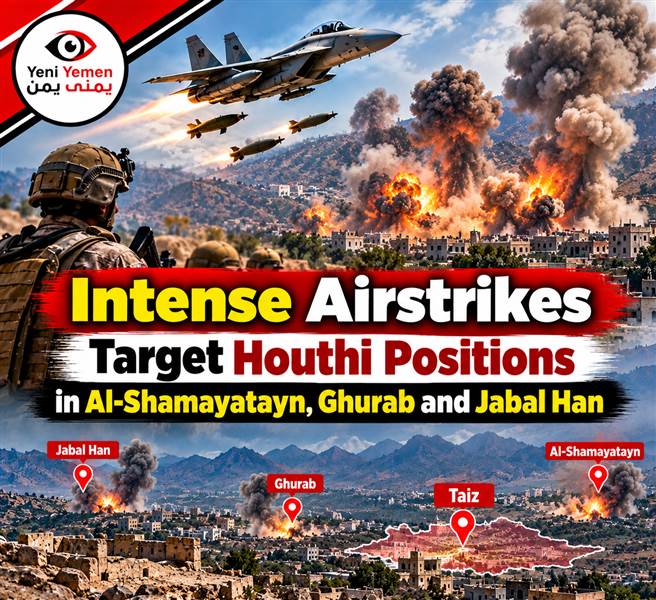
According to the sources, the strikes targeted areas in the southern district of Al-Shamayatayn, including Jabal Sabran, the surroundings of Al-Turbah, and Al-Asabih.
Additional operations were reported west of Taiz city, targeting Houthi positions near Al-Dhanin Hill and Ghurab, as well as military reinforcements moving toward Jabal Han.
Government forces also reported repelling several Houthi attacks on positions surrounding the city.
The results of the airstrikes and the extent of military losses have not been independently verified.
Yemeni Army Reports Extensive Military Operations
The Yemeni military said it was continuing operations under the campaign known as “Yemen's Dawn,” launched on October 5.
Government forces reported conducting more than 700 operations against Houthi positions over a 24-hour period on Saturday, claiming that more than 300 Houthi fighters had been killed.
According to military officials, the operations targeted command centers, weapons depots, military vehicles, fortifications, and supply routes across several fronts.
These figures remain claims by the government forces and have not been independently confirmed.
The continuing operations reflect the intensification of fighting across multiple areas, including Taiz, Lahj, and regions near the strategically important Bab al-Mandeb Strait.
Taiz Siege Deepens Humanitarian Emergency
The city of Taiz, one of Yemen's largest urban centers, continues to suffer from years of siege, restricted access, and recurring fighting.
Recent military escalation has further disrupted the delivery of fuel, medicine, food, and other essential supplies.
Humanitarian organizations have warned that fuel shortages are severely affecting hospitals, water-pumping stations, and waste collection services.
The rising cost of drinking water, shortages of medical supplies, and deteriorating sanitation conditions have increased the risk of disease outbreaks.
Children, elderly residents, and patients requiring regular medical treatment are among the most vulnerable.
The United Nations has warned that approximately 800,000 people in Taiz face serious risks as humanitarian access becomes increasingly restricted.
Human rights organizations have also reported civilian deaths and injuries resulting from recent attacks attributed to Houthi militias.
The situation highlights the urgent need to protect civilians, reopen essential roads, and guarantee safe humanitarian access.
Houthi Missile Attacks Raise Regional Security Concerns
The conflict has also intensified beyond Yemen's borders.
On Sunday, the Saudi-led coalition reported intercepting ballistic missiles and drones launched by Houthi militias toward Saudi territory.
The coalition said its air defenses intercepted ten ballistic missiles heading toward southern Saudi Arabia, alongside additional missile and drone threats targeting Riyadh and Khamis Mushait.
Saudi authorities reported that falling debris from intercepted missiles caused injuries and damage to civilian property.
The attacks have renewed concerns about regional security, civilian safety, and the potential consequences for transportation and critical infrastructure.
Understanding the Yemen Conflict
The origins of Yemen's current war lie in an internal struggle over political authority and control of state institutions.
In September 2014, Houthi militias seized Sanaa, fundamentally altering the country's political and security landscape.
In March 2015, a military coalition led by Saudi Arabia intervened in support of Yemen's internationally recognized government.
Therefore, portraying the conflict solely as a war between Yemen and Saudi Arabia overlooks its domestic origins and the confrontation between the Yemeni government and Houthi militias.
At the same time, the conflict has developed significant regional dimensions through foreign involvement, cross-border attacks, and threats to strategic maritime routes.
A comprehensive understanding of the war requires acknowledging both its internal political roots and its broader regional consequences.
The Road Ahead: Civilian Protection and Political Stability
As military operations continue, protecting civilians and ensuring uninterrupted humanitarian assistance remain urgent priorities.
Reopening roads into Taiz, restoring essential healthcare services, and securing access to food, water, and fuel are critical steps toward preventing further humanitarian deterioration.
Ultimately, sustainable peace will require an end to violence, the restoration of effective state institutions, and an inclusive political settlement that safeguards Yemen's sovereignty and the rights of its people.
Yeni Yemen | Yemen Today
"What is happening in Yemen? What caused the war? And who ignited it?
Also read
Yemeni Presidential Leadership Council Chairman Dr. Rashad Mohammed Al-Alimi announced on Sunday the start of military operations aimed at retaking the remaining Yemeni territories...
The Arab Coalition supporting Yemen’s internationally recognized government has denied claims by the Houthi militia that it targeted the Saudi capital, Riyadh, describing the alleg...





Comments