

Abdrabbuh Mansur Hadi's Legacy: Defender of Legitimacy or President of Yemen's Collapse Era?
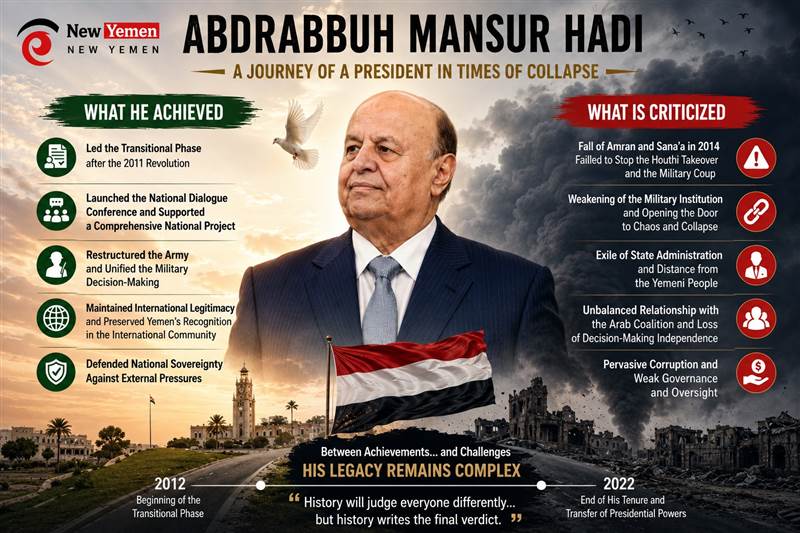
Former Yemeni President Abdrabbuh Mansur Hadi remains one of the most controversial figures in modern Yemeni history. Supporters view him as the leader who preserved Yemen's international legitimacy and stood against the Houthi coup, while critics associate his tenure with the collapse of state institutions and the fall of the capital, Sana’a.
After serving for 17 years as Vice President under the late President Ali Abdullah Saleh, Hadi assumed the presidency in 2012 as a consensus candidate under the Gulf Initiative. However, his lack of a strong political base and a fully loyal military establishment became major challenges throughout his presidency.
One of the most debated decisions during Hadi's rule was the restructuring of the Yemeni armed forces. Supporters argue that it dismantled entrenched power centers within the military, while critics believe it weakened professional combat units and indirectly facilitated the Houthi advance.
The fall of Amran and later Sana’a to Houthi forces in 2014 remains the heaviest burden on Hadi’s political legacy. While many hold him responsible for failing to prevent the collapse, others point to a combination of military divisions, security weaknesses, and political turmoil that had already undermined the state.
Despite losing control on the ground, Hadi managed to preserve Yemen’s international legitimacy. Securing UN Security Council Resolution 2216 and maintaining international recognition for the Yemeni government are widely regarded as his most significant diplomatic achievements.
His relationship with the Arab Coalition remains another highly debated issue. Supporters argue that coalition support was essential for the survival of the internationally recognized government, while critics believe it came at the expense of Yemen’s independent decision-making process.
In April 2022, Hadi transferred his powers to the Presidential Leadership Council, bringing nearly a decade of leadership to an end. However, his primary wartime objective—the restoration of government control over Sana’a—remained unfulfilled.
Today, Hadi's legacy continues to divide opinion. To some, he was a legitimate leader who defended the Yemeni state against a coup. To others, he was unable to prevent the collapse of state institutions during one of the most turbulent periods in Yemen’s modern history.
"What is happening in Yemen? What caused the war? And who ignited it?
Also read
Yemeni Presidential Leadership Council Chairman Dr. Rashad Mohammed Al-Alimi announced on Sunday the start of military operations aimed at retaking the remaining Yemeni territories...
The Arab Coalition supporting Yemen’s internationally recognized government has denied claims by the Houthi militia that it targeted the Saudi capital, Riyadh, describing the alleg...






Comments