

Analytical Reading: How Did the Houthi Militias Destroy Yemen and Turn It into a Card in Iran’s Hands?
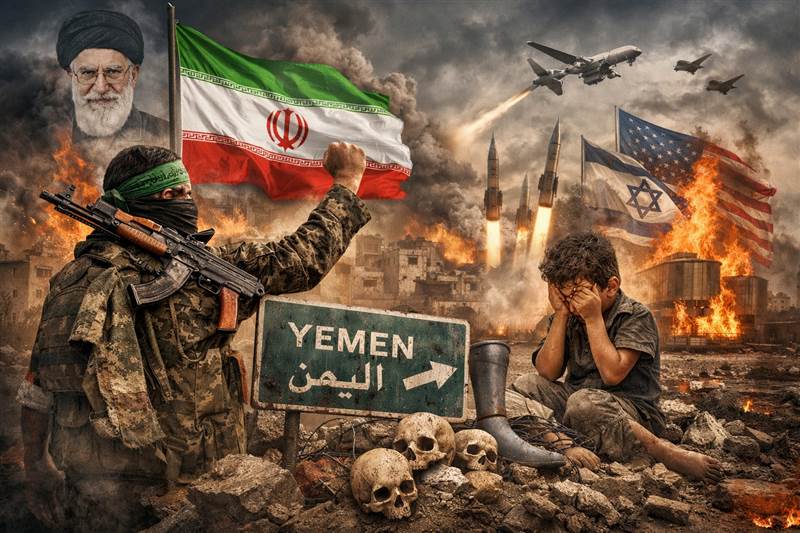
Since the Houthis staged their coup and seized control of the Yemeni capital, Sana’a, in September 2014, Yemen has not moved toward the “liberation” promised by revolutionary slogans. Instead, it has taken the exact opposite path: the fragmentation of state institutions, the division of financial and administrative authority, economic decline, widening repression, the expansion of a war economy, and the transformation of Yemen from a troubled state into an open arena for regional conflicts.
According to the United Nations, 19.5 million Yemenis will require humanitarian assistance in 2025, while 17 million people are expected to face acute food insecurity. These figures alone summarize the scale of collapse that has deepened throughout the years of war.
What Have the Houthi Militias Done to Yemen?
The short answer is this: they turned the state into a paralyzed structure, society into an exhausted mass, and the economy into one driven by siege, extortion, and war.
The World Bank reported that Yemen’s GDP contracted by 1% in 2024, following a 2% contraction in 2023, while real per capita income has fallen by 54% since 2015. It also noted that the continued disruption of oil exports contributed to a 42% drop in the revenues of the internationally recognized government during the first half of 2024. Domestic revenues then fell to only 2.5% of GDP in 2024 — an extremely fragile level for a country that still needs to finance salaries, public services, and imports.
But the collapse was not merely economic. The United Nations and UNDP had previously estimated that the war in Yemen could lead to 377,000 deaths by the end of 2021, most of them indirect deaths caused by hunger, disease, and the collapse of essential services. The war also pushed Yemen’s development back by 21 years. These are not propaganda figures; they are a direct measure of the cost of a prolonged war in which civilians have become the primary losers every single day.
A Rule Built on Repression, Not Statehood
On the ground, the Houthis entrenched a model of governance based on coercion and securitization rather than state institutions. Human Rights Watch documented that the Houthis and other parties engaged in arbitrary detention, enforced disappearances, and torture. However, it specifically highlighted the Houthis in 2025 and 2026 for escalating detention campaigns targeting UN personnel, civil society actors, and political opponents.
By the end of 2025, the Houthis were holding 69 UN staff members and dozens of civil society workers, while human rights organizations repeatedly documented concerns over torture and mistreatment inside Houthi-run detention centers. This reveals that behind the rhetoric of “resistance” lies a deeply repressive apparatus.
The Militarization of Childhood
One of the most dangerous consequences of the war has been the devastation of an entire generation. The United Nations continues to list the Houthis among parties responsible for grave violations against children because of their recruitment and use of child soldiers.
The UN documented at least 1,851 confirmed cases of child recruitment or use by the Houthis since 2010, while rights groups estimate the real number to be far higher. This means the group has not only dismantled the state, but has also militarized childhood itself and consumed Yemen’s future.
Landmines: A Lasting Architecture of Fear
If the economy has collapsed, landmines have ensured that destruction remains permanent and long-term. Yemen is now one of the most heavily contaminated countries in the world with mines and explosive remnants of war.
The official report submitted under the Mine Ban Treaty identified 147 known or suspected areas contaminated with anti-personnel mines, covering approximately 7.98 million square meters. Meanwhile, the Landmine Monitor recorded 265 casualties from mines and explosive remnants of war in Yemen during 2024 alone.
These are not side effects of war; they are an embedded structure of fear planted into the land itself, disrupting agriculture, grazing, movement, and any normal return to life.
Whose Interests Are the Houthis Serving Regionally?
Politically and militarily, it is difficult to separate the Houthis from Iran’s broader regional strategy. International agencies such as Reuters and the Associated Press have repeatedly described the group as Iran-backed, while the group itself recently announced its readiness to engage militarily in support of Tehran, and then carried out its first missile attack toward Israel since the outbreak of the current war involving Iran.
This positioning does not serve Yemen’s direct national interests. Instead, it places Yemen inside a much broader “axis” equation, where the timing and direction of escalation are dictated by regional priorities — not by Yemeni needs.
Yemen as a Threat Platform, Not a Recovering State
The result is that Yemen is no longer viewed externally as a country trying to recover, but rather as a platform for maritime and missile threats.
Houthi attacks on Red Sea shipping forced global trade to alter its routes. UNCTAD reported that shipping through the Suez Canal dropped by 45% within just two months at the beginning of 2024 due to those attacks.
In March 2026, Reuters warned that the world’s failed attempt to secure the Red Sea against Houthi attacks had made any future threat to the Strait of Hormuz far more dangerous and costly.
In simpler terms, the Houthis did not “defend the Muslim nation” in practice — they increased transportation, energy, and insurance costs for everyone, including Yemenis themselves.
What Are the Real Outcomes of Their Conduct and Rhetoric?
The Houthi narrative is built around grand slogans: القدس (Jerusalem), الأمة (the Muslim nation), sovereignty, and confronting America and Israel. But the actual outcome inside Yemen is completely different.
There is no national liberation — only structural fragmentation of state institutions, currency, and economic decision-making. There is no prosperity — only a shattered economy, deeper poverty, and greater dependency on aid. There is no “protection of dignity” — only a climate of arrests, forced mobilization, child recruitment, and repression of civil society.
This gap between slogan and outcome is what most clearly reveals the nature of the project: a transnational mobilizing discourse with deeply destructive local consequences.
Where Is the Greatest Contradiction?
The greatest contradiction is this: the group claims to speak on behalf of the oppressed, while Yemen — in both Houthi-controlled and non-Houthi-controlled areas — has become one of the most miserable countries in the world.
According to the United Nations, more than half the population needs assistance, and millions of children are living amid hunger, malnutrition, educational disruption, and ongoing security threats. When the Houthis detain aid workers and obstruct humanitarian organizations, they are not resisting “global arrogance”; they are tightening the pressure on the very society they claim to defend.
Conclusion
What the Houthis have done to Yemen can be summarized in five hard outcomes:
- Hijacking the state and transforming it from institutions into a de facto authority.
- Destroying the economy and deepening poverty, hunger, and financial fragmentation.
- Repressing society through arrests, forced mobilization, recruitment, and shrinking civic space.
- Turning Yemen into an Iranian platform in a regional conflict whose priorities are not determined from Sana’a or by Yemeni interests.
- Exposing the country to more strikes, isolation, and risks in the name of slogans that have never translated into bread, safety, or dignity for the people.
In other words, the Houthis did not lead Yemen toward a project of national revival — they led it into a project of exhaustion and depletion. They raised the slogan of defending the الأمة, but the ordinary Yemeni has reaped hunger, fear, displacement, and landmines, while the country itself has been transformed into a bargaining chip and conflict arena in the hands of a larger regional axis.
That is the clearest truth when measured by facts and figures — not by slogans.
Also read
Abdulrahman Qahtan, the son of missing Yemeni political leader Mohammed Qahtan, has revealed shocking details about the human remains handed over by the Houthis to the Joint Veri...
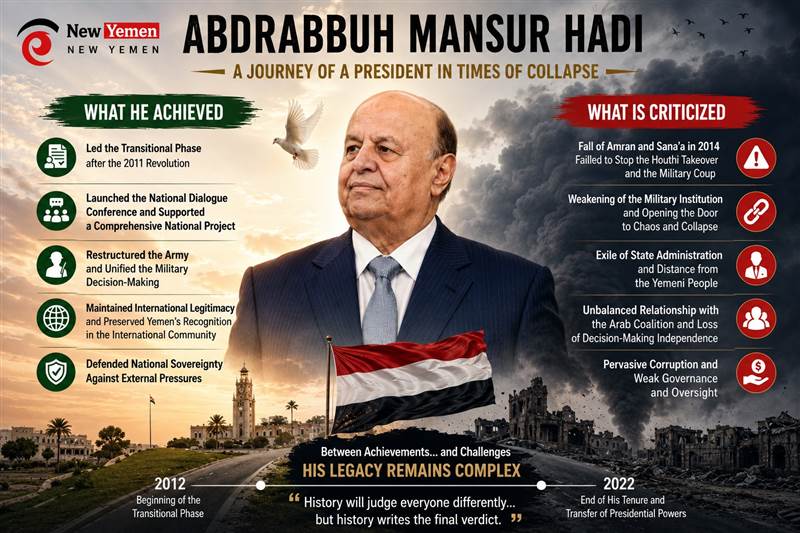
Former Yemeni President Abdrabbuh Mansur Hadi passed away today in the Saudi capital, Riyadh, according to Yemeni media outlets and sources close to the former leader. Hadi had lar...



Comments